The first commercial decaffeinated coffee came out of Germany in the early 1900s. Ludwig Roselius, a Bremen coffee merchant, found a way to steam the beans and then wash the caffeine out with benzene. His company sold it as Kaffee HAG.
Benzene causes leukemia. That wasn’t well understood in 1906, and it was eventually dropped, but the basic approach stuck around for decades: soak green coffee beans in an organic solvent that dissolves caffeine, then drive off the solvent. Methylene chloride (dichloromethane) became the standard. Ethyl acetate is another common choice and gets marketed as “naturally decaffeinated” because it also occurs in fruit, though the stuff used industrially is usually synthetic.
Methylene chloride is still used for some decaf today. Residue limits are low and most of it evaporates during roasting, but in 2023 several environmental and health groups petitioned the US FDA to ban it for coffee anyway, since it’s a probable carcinogen.
What supercritical means
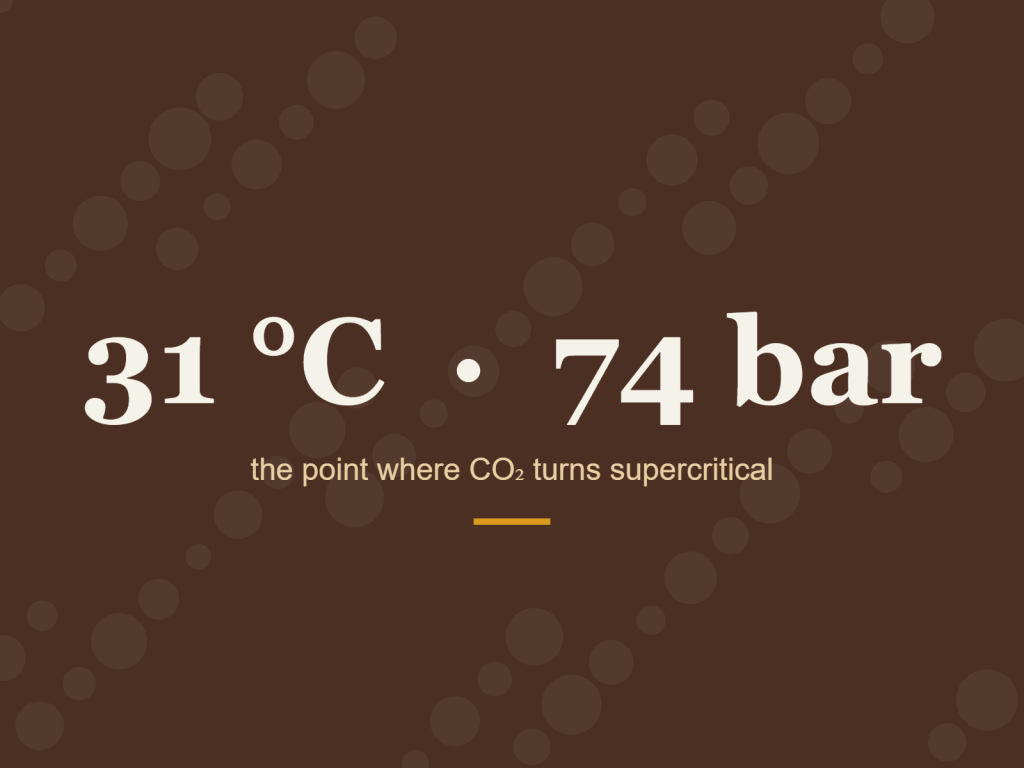
Carbon dioxide has a critical point at about 31 °C and 74 bar. Above both of those, it stops behaving like a normal gas or a normal liquid. It fills its container like a gas, but it’s dense enough to dissolve things like a liquid. That’s a supercritical fluid.
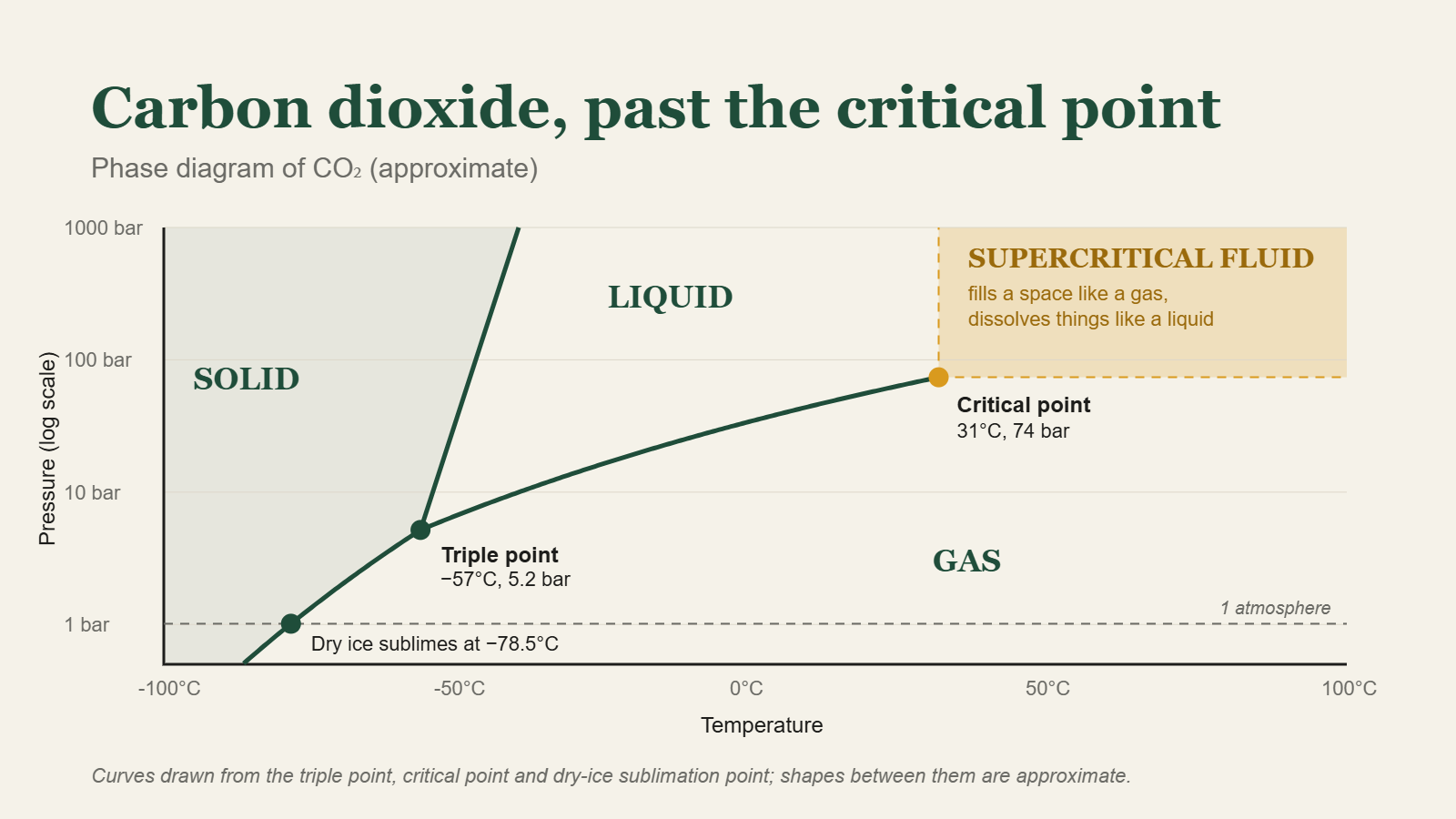
The useful part is that you can tune it. Small changes in pressure and temperature change how well supercritical CO2 dissolves a given compound. Set the conditions right and it pulls caffeine out of moistened coffee beans while leaving most of the flavor compounds behind.
Kurt Zosel at the Max Planck Institute for Coal Research in Mülheim worked this out and patented the process around 1970. HAG, the same company that started with benzene, built commercial plants using it later that decade.
Why chemists like it
When you’re done, you drop the pressure and the CO2 turns back into a gas. No solvent residue stays in the beans, so there’s nothing to drive off. The caffeine gets recovered, often with water or activated carbon, and sold to soft drink and pharmaceutical makers. The CO2 is recycled within the plant.
It’s also non-flammable and cheap, and it’s usually a byproduct captured from other industrial processes, so using it doesn’t add new CO2 to the air.
The catch
High-pressure equipment is expensive. A supercritical extraction plant costs far more to build than a solvent soaking tank, which is why this method mostly shows up in large operations. Running at 200-plus bar also takes energy.
Still, the same technique has spread. It’s used to extract hop oils for beer, essential oils for perfumes, and in some dry cleaning systems as a replacement for perchloroethylene, a solvent with its own health problems. The idea is the same in each case: find a solvent that leaves no trace, and the cleanup problem mostly goes away.


Leave a Reply