Sitagliptin is a type 2 diabetes drug, sold by Merck as Januvia. Making it involves a step where you have to put an amine group onto a carbon atom with the right three-dimensional orientation. Get the handedness wrong and you have a different molecule that doesn’t work the same way in the body.
Merck’s first commercial route did this with a rhodium catalyst under high-pressure hydrogen. It worked. But rhodium is one of the most expensive metals there is, traces of it had to be removed from the final drug, the reaction needed special high-pressure equipment, and the product came out a little short on stereochemical purity, so it needed an extra crystallization step to clean up.
Asking an enzyme to do it
Enzymes are good at exactly this kind of problem. A family called transaminases moves amine groups onto ketones, and they naturally produce one handedness. The trouble was that no natural transaminase would accept the sitagliptin precursor. It was too big and too different from what these enzymes evolved to handle.
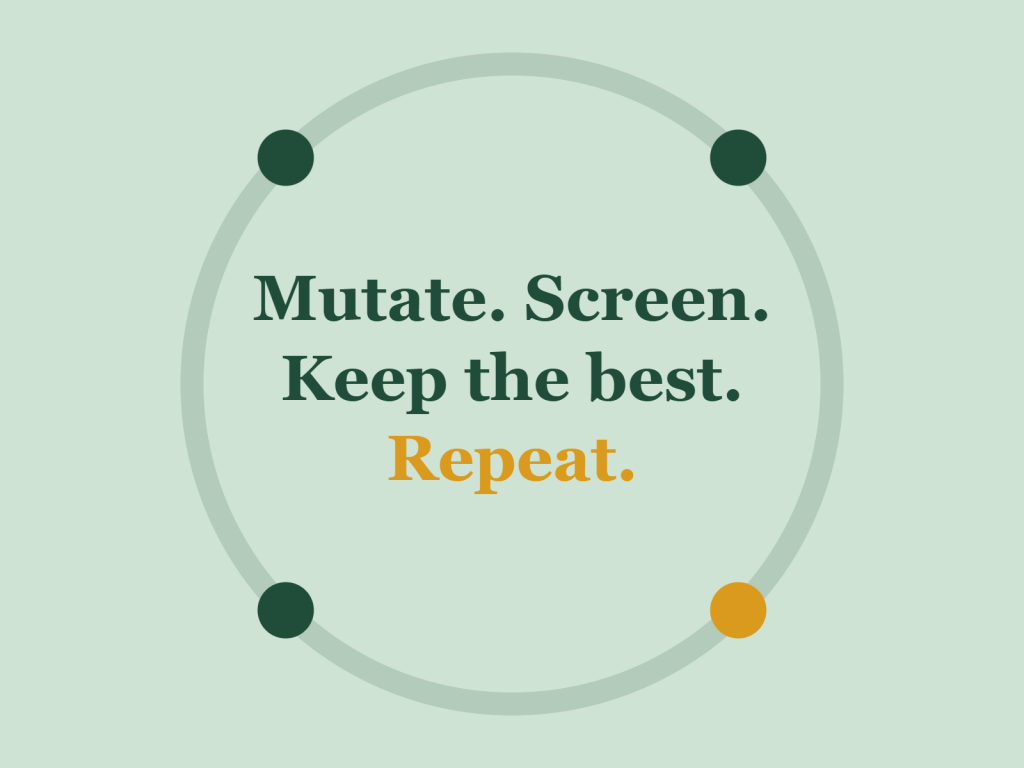
Merck worked with Codexis, a California company that specializes in engineering enzymes, to make one that would. They used directed evolution: start with an enzyme that barely does what you want, make lots of random and targeted mutations, test which variants do slightly better, keep the winners, and repeat. Frances Arnold, who developed much of this approach, shared the 2018 Nobel Prize in Chemistry for it.
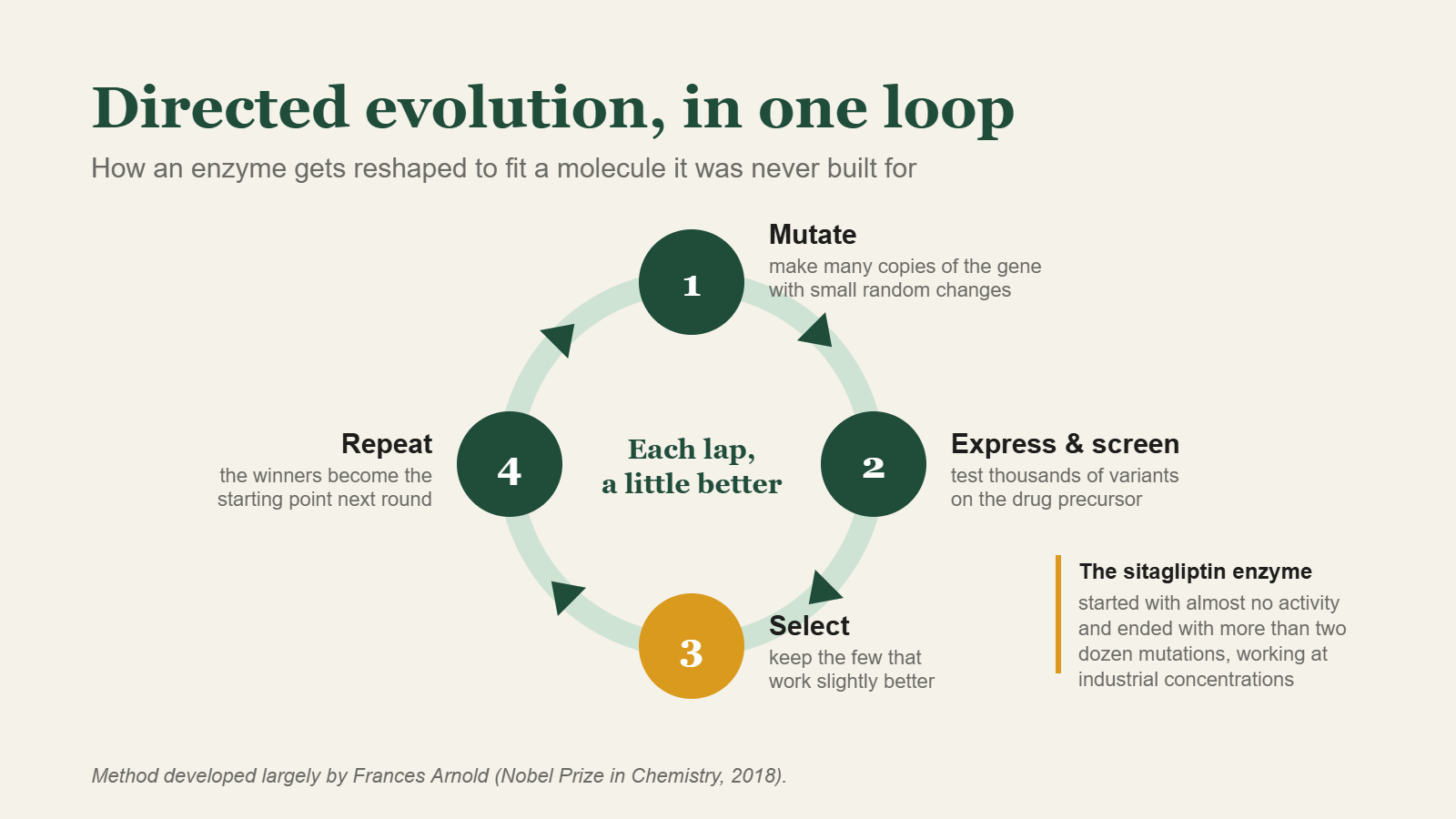
The starting enzyme had almost no activity on the target. After repeated rounds, the final version carried more than two dozen mutations and could run the reaction at industrial concentrations, in a solvent mix that would denature most natural enzymes.
What changed
According to the numbers Merck and Codexis reported when the process won a US Presidential Green Chemistry Challenge Award in 2010, the enzymatic route:
- raised overall yield by 10 to 13 percent
- cut total waste by 19 percent
- removed the need for rhodium and high-pressure hydrogenation equipment
- increased productivity (kilograms per liter per day) by about half
It also delivered the right stereochemistry so cleanly that the extra purification step wasn’t needed.
The bigger point
For a long time enzymes were treated as fragile, picky, and fine for making beer but not for a pharmaceutical plant. The sitagliptin case is one of the reasons that view has changed. If you can evolve an enzyme to fit your molecule, you get a catalyst that runs in water-based conditions near room temperature, is biodegradable, and contains no heavy metals.
The cost is time up front. Evolving that transaminase took serious work before a single kilogram of drug was made. For a drug that sells in large volumes for years, though, that investment pays back, and more pharmaceutical companies now have enzyme engineering teams of their own.


Leave a Reply