Chemists used to judge a reaction mostly by its yield. If you started with a mole of starting material and got 0.9 moles of product, that was a 90% yield and a good day at the bench. Nobody asked much about everything else that came out of the flask.
In 1991 Barry Trost at Stanford published a paper in Science that asked a different question: of all the atoms you put into a reaction, how many end up in the thing you actually want? He called it atom economy. A reaction can have a great yield and still throw most of its mass away as byproducts, because the yield only counts the product, not the leftovers.
Ibuprofen is the example almost every green chemistry course uses, and it holds up.
The original route
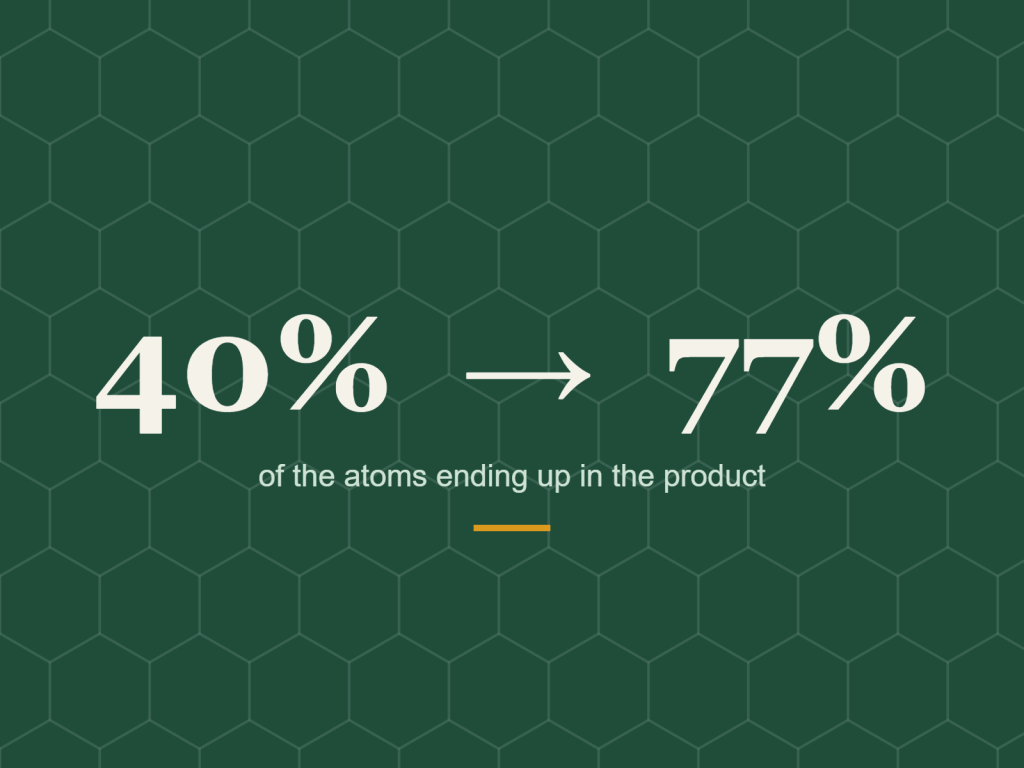
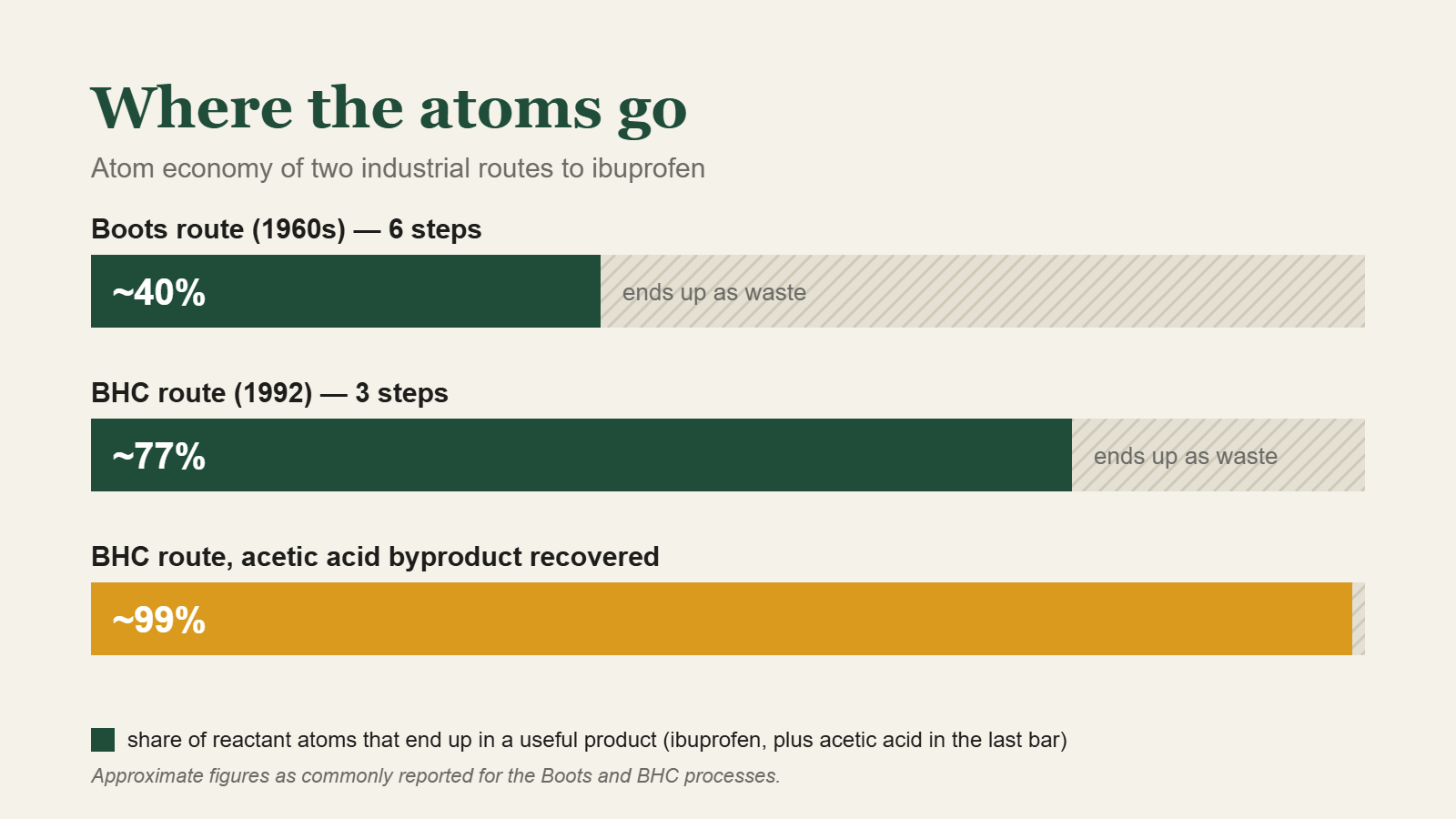
Boots, the British pharmacy company, developed ibuprofen in the 1960s. Their manufacturing route took six steps. Each step brought in reagents whose atoms mostly didn’t survive into the final molecule, and the overall atom economy came out around 40%. For every kilogram of ibuprofen, more than a kilogram of other stuff had to be dealt with as waste. At the scale ibuprofen is made, that is a lot of waste.
The redesign
In the 1980s, a joint venture between Boots and Hoechst Celanese (the BHC Company) worked out a three-step route. The main changes were catalytic. Instead of using reagents that get consumed, the new process leaned on catalysts that do their job and come back out:
- hydrogen fluoride acts as both catalyst and solvent in the first step, and gets recovered and reused
- a Raney nickel catalyst handles a hydrogenation
- a palladium catalyst runs a carbonylation that adds carbon monoxide directly to the molecule
That last step is neat. Carbon monoxide gets incorporated whole, so none of its atoms are wasted.
The atom economy of the new route is about 77%. The main byproduct is acetic acid, which is useful, and when it’s recovered and sold the effective figure gets close to 99%. The BHC plant in Bishop, Texas started up in 1992, and the process won a US Presidential Green Chemistry Challenge Award in 1997.
Why this example keeps getting taught
Part of it is that the numbers are so clean. Half the steps, roughly double the atom economy, and a byproduct with a buyer.
The other part is that the green route was also the cheaper route. Fewer steps means less equipment, less energy, less time, and less money spent disposing of waste. Green chemistry sometimes gets pitched as a cost companies accept for ethical reasons. The ibuprofen story is a case where it was just better engineering.
Atom economy has limits as a measure. It ignores solvents, energy, and how toxic the byproducts are, which is why people also use metrics like the E-factor (kilograms of waste per kilogram of product). But as a first question to ask about a synthesis, “where do the atoms go?” is a good one, and it wasn’t routinely asked until about thirty-five years ago.


Leave a Reply